AAAAAlE/b-mwTllxhc8/s320/Blog_OffTheMap_Final.jpg" />
Friday, 25 October 2013
Fabulous resource for writers and readers of historical fiction
How often have you walked through a city, London for example and wished you could travel back in time to see it in, say, the Elizabethan period or during the time of Dickens, maybe to see the streets where Sherlock Holmes solved his cases? Well now, due to the expertise and sheer hard graft of a group of students at Pudding Lane Productions, you can and you can see it here. I had hoped to upload the video from YouTube but unlike these brilliant students, my grasp of all things technical is so puny, I couldn't manage it. Do go and look though, it is brilliant. They have produced this amazing fly-through of 17th century London. This has deservedly won First Prize in the Off the Map challenge, using historical data from the British Library so it is startlingly accurate. The group's blog (click here) gives fascinating insight into the detail they strove for - haunches of meat hung up at the butchers, bunches of wood as carried for kindling, the accurate representation of one of London's famous bridges. It is this attention to detail as well as their creativity that has created such an atmospheric experience. This is invaluable for both writers and readers of historical fiction, so that while we are reading maybe Samuel Pepys wonderful diaries, we can look at this wonderful visual representation and feel we are there. How long will it be I wonder before e-books have such 'fly-through' screens so that you can watch as you read to enhance the experience of reading a historical novel (I'm sure someone somewhere is already doing that!) Well done Crytek for making the award. And, from a novel writer who loves this period of history, thank you SO MUCH Pudding Lane Productions and all you talented students, for transporting me back to the past, almost as good as a time machine!  AAAAAlE/b-mwTllxhc8/s320/Blog_OffTheMap_Final.jpg" />

Tuesday, 10 September 2013
Analysing 'What Remains' BBC drama
As I am writing a crime novel at present I find I am fascinated by well written crime and how writers create a gripping plot and characters. Myself, I'm not one for lots of action, give me a good story though and I'm hooked. I have found 'What Remains' gripping for a number of reasons which I believe can apply to novels just as to TV drama. The last episode of this great whodunit airs this Sunday, and the DVD will be available soon. The plot is very simple. A young woman's long dead mummified body has been found in the attic of an old house which is split up into flats. Many of the inhabitants have been tangled up in her life but no one cared enough to even worry where she had gone to when she disappeared. The reason I'd recommend it to crime writers is as follows.
 First and foremost the Detective brilliantly underplayed by David Threlfall. We immediately sympathise with Detective Len Harper for a number of reasons that are a lesson in 'layering' your characters and making them interesting. Firstly, we feel sorry for him because he is just about to retire from the job he loves and leaving his workmates who respect and admire him. He's obviously good at his job and it is compelling to have characters who are good at what they do, whatever they do, even if they are contract killers (remember the James Fox character in the 'Day of the Jackal'). DI Harper loves his job so much that even after his last day, he's back at the scene of the crime, not having told the inhabitants of the house that he actually has no right any longer to be there. The reason? He's the only person who cares a jot about the girl who died. Another tick in the box for him as a fascinating character. He's a champion of the weak and oppressed. He's the sort of person we'd like to be if only we had the time, if only we didn't have other commitments etc etc. He is the person we want a hero to be and we are convinced right from the beginning that with his skills and determination he will give that lonely dead girl justice. Poor Detective Harper lives on his own having lost his wife only a year before. We really want him to have friends because he's a good guy and one of the most touching scenes was where he arranges for his neighbour to come round for a drink and the other guy just forgets and never turns up. This is perfect show don't tell stuff. DI Harper doesn't mope around feeling sorry for himself or knock on the neighbour's door making a nuisance of himself, but he does consume a fair quantity of whiskey and we know that being snubbed in this way is rough. We therefore cheer inwardly when he unexpectedly scores with a nice woman at the archery class he goes to and we know there is at least one night when DI Harper didn't sleep in a cold lonely bed! Other examples of layering of his character is the way he deals with the hideous young teenager who has been into the dead girls flat and scrawled mean graffiti on her wall. The cocky kid is grabbed in an arm lock by DI Harper and told in no uncertain terms what a little **** (insert 4 letter word of your choice here) he is. You've been waiting for 3 episodes for someone to do that to the little turd.
A hugely compelling factor to this story is that you know Detective Harper only has a limited amount of time to catch his killer. Sooner or later people will discover he's no longer a bona fide member of the Force and he'll either have to find his killer or stop asking questions. A time constraint is an extremely useful device for any story because it ups the tension no end. You only have to think of countless wonderful movies such as 'Limitless' with the superb Bradley Cooper to know how giving a clearly defined mission in a story a time limit puts the reader or viewer on the edge of their seat thinking, will he make it, won't he?
There, I had thought I would cover all the characters in one (slightly too long) blog post but in fact there are so many layers to the one main character that I've gone on much longer than I thought I would. The episodes are still available on BBC I-player and the last one is this Sunday. I shall be watching again, just to garner all the elements I can of what makes good drama!
Sunday, 1 September 2013
The Way, Way Back - Analysis using Michael Hauge's 'Writing Screenplays that Sell'
I'm addicted at present to Michael Hauge's excellent book on writing screenplays because there's a lot which can be applied to story writing generally. As I am halfway through my first mainstream novel attempt, analysing what makes a story successful has become a bit of an addiction with me. Last night we went to see 'The Way, Way Back' starring Steve Carrell (this time uncharacteristically in a bit of a bad boy role) and Toni Collette. So I thought I'd see how this new film about a fraught family holiday to the seaside shaped up against Hauge's writing tips. Please beware, for anyone who hasn't yet seen the film, there are spoilers here!
1. The primary goal of any filmmaker is to elicit emotion in the audience. Box certainly ticked here, it's a movie about families, first love, the pain of adolescence, need I say more!
2. Hollywood movies (and it's the same with popular novels)are about characters pursuing visible goals with clearly defined finish lines. Top marks here as the main character Duncan (a painfully shy teenager) has the clear visible goal of surviving a family holiday even though his mother's new boyfriend the overbearing and judgemental Trent (his nemesis) is on board and clearly out to establish his power over the family.
3. There are five compelling elements that will increase the commercial potential of your story these are: to win; to stop; to escape; to deliver and/or to retrieve. The Way, Way Back does tick quite a few of these in that Duncan wants to win his mum's love and loyalty, he wants to stop her relationship with Trent, he wants to escape from a grim family holiday and possibly to retrieve his parents' ruined relationship.
4. Character arc. There are a number of clear character arcs here. Duncan gains the confidence to say what he wants and be heard. His mother, Pam, decides not to be treated like a doormat - during the middle of the film she says she is prepared to put up with Trent's infidelity because she is scared of losing him but by the end she visibly goes to sit by her son, thus siding with him and risking Trent's disapproval. The character Owen, played by Sam Rockwell who is a wisecracking dude, opens up to Duncan and shows his serious side in order to help Duncan overcome his problems. Susanna and Peter, the next door neighbours kids although smaller players in the drama both change. Susanna who has risked staying with a bitchy bunch of friends, breaks away and establishes her own self and Peter her brother who is somewhat under his mother's thumb runs away to join Duncan on his adventure at the water park and is given confidence by Owen, the manager there who is mentor to both the boys.
5. Theme - the theme of the story is encapsulated in the title. It's about not being pushed around. The Way, Way Back I understand is the name for the back seat of a Buick which is where poor old Duncan sits on his own, pushed back there by the overbearing Trent. The beginning scene of the book has him sitting there looking forlorn and being picked on by Trent who viciously asks him to rate himself on a scale of one to ten. When Duncan modestly says he might be a six, Trent rates him a three and taunts him to do better. The last scene of the film still has Duncan in the back but by then he has won his mother's loyalty and she goes to sit in back with him thus demonstrating that he has achieved the visible goal of trumping Trent and showing him up for what he truly is - a bully.
6. The three essential methods for creating immediate empathy with your hero are: 1) sympathy - a victim of undeserved misfortune. Duncan is definitely this in that his mother has chosen someone who is deeply unsympathetic to his needs. 2) Jeopardy - in danger of losing something of great value to the hero - Duncan right from the start is in danger of losing his mother's loyalty. 3) Likeability - possessing one or more of the following qualities, kind, good hearted and generous, well-liked and funny. This one's more difficult. We do feel sorry for Duncan but he's awkward, no one seems to like him much, he's oppressed - however, because he is so young, we give him a chance. Many teenage boys are introverted and uncomfortable, the hope is that they will overcome their ugly duckling status and turn into adult swans. Overall I think Duncan's better qualities come out in him as the story develops. Right from the start, you are willing for him to turn out to be a nice guy which, of course, by the end he is. Part of the reason for the viewer to stay with the story is to watch this capacity in him to be liked and loved unfold. The key scene in us realising this goal has been reached is when the beautiful next door neighbour Susanna kisses him. If someone that lovely can want him, we know he must be a good guy.
7. Ground rules for creating primary characters are that there should be a hero (the main character whose motivation drives the plot and with whom we most closely empathise) - we have that in spades with Duncan, a nemesis (the character who most stands in the way of the hero achieving their outer goal). Trent is a clear nemesis, if we look at Duncan's visible goal which is to survive a family holiday with his pride in tact, Trent is the one who is most likely to scupper that. Then we have a character who should be the Reflection (the character who most supports the hero's outer motivation). This is clearly Owen, the manager of the water park. He is the one to whom Duncan runs to find some relief from his awful home life and it is Owen who shows the boy that he can face danger and come out on top. The key scene here is where Owen sends Duncan in to tackle a group of kids who are breakdancing in the water park and gathering a crowd and who have to be stopped. Duncan is petrified, and when the group challenge him to show them his moves he rises to the challenge. They accept him and he gains visibly in confidence. The other key scene is when a trio of kids get stuck in one of the water rides. Instead of doing the sensible thing, Owen, who is a risk-taker and bucks authority decides to clear the blockage by sending another, heavier kid zooming down the water slide to flush them out like peas popping out of a pea shooter. Clearly this is a pretty dangerous thing to do (and Owen gets told off for it by his sensible employee, Caitlin. Nevertheless his high risk strategy does the job thus demonstrating to Duncan that being brave, even if it also might be foolhardy can win the day. Seeing this helps Duncan to take risks and 'out' the philandering Trent in front of everyone at a party. Clearly a high risk strategy which has fallout but in the end, works.
We enjoyed the film and I have found that analysing it against Michael Hauge's great book, 'Writing Screenplays that Sell' has been really useful in helping me develop my own story. Now, enough of this procrastinating, back to writing my own novel......
Tuesday, 27 August 2013
Creating atmosphere/setting the scene in your writing
I was struck today sitting in a new coffee and cake shop at how important it is to create atmosphere. Obviously we try to do this in our writing, but it is done every day in various ways that we hardly notice. Yet there is a kind of magic conjured up when atmosphere is created. If we can inject a little of that magic into our stories, they will come alive. This picture I hope demonstrates what I mean. This new coffee shop, Dolce Dolce is in Purley where the only other coffee shop I frequent is Costa. Dolce Dolce used to be a pizza parlour but it has been TRANSFORMED in a simple but magical way. As they are primarily a wedding business creating cakes and other goodies for special events, the creation of a light, airy, romantic feel is important in letting people know what the business is all about. Firstly everything has been painted white and there are wispy folds of light curtaining at the window. What isn't white has been painted gold so that what might have been dull, dark wood is burnished. Cleverly, the owner, Antoinette, has scattered lovely old pieces of furniture, coffee tables, and chaises longues throughout and covered them in pastel and ivory fabrics. A long counter full of cup cakes and apricot and almond tarts have made it look like a French patisserie and mirrors reflect all the goodies back at you. When you see a sign like this garlanded in its own little frame with golden curlicues you know you're not in Costa!
 The cups and saucers which instead of being a uniform colour or shape are a variety of wonderful mix and match pieces of old Aynsley and other ware is presented with gold pastry forks and eating out of a cornucopia of different tea sets is unusual and fun. Finally, 4 chandeliers complete the picture and pictures are what I'm talking about. For when we set the scene in our books and short stories, it only takes a few sentences to sum up where your characters are. But these sentences have to be well chosen and create atmosphere. I critique a lot of manuscripts and I often find one scene blurs into another because the author hasn't given places an identity. A few well chosen sentences to paint a picture are all that is needed to breathe life into a story. Dolce Dolce is like a film set and all the better for it. The next time you are sitting somewhere which has a strong atmosphere, jot down notes and analyse what visuals and scents make it come alive and I guarantee this can be used to push your writing up another notch.
 This new coffee shop, Dolce Dolce is in Purley where the only other coffee shop I frequent is Costa. Dolce Dolce used to be a pizza parlour but it has been TRANSFORMED in a simple but magical way. As they are primarily a wedding business creating cakes and other goodies for special events, the creation of a light, airy, romantic feel is important in letting people know what the business is all about. Firstly everything has been painted white and there are wispy folds of light curtaining at the window. What isn't white has been painted gold so that what might have been dull, dark wood is burnished. Cleverly, the owner, Antoinette, has scattered lovely old pieces of furniture, coffee tables, and chaises longues throughout and covered them in pastel and ivory fabrics. A long counter full of cup cakes and apricot and almond tarts have made it look like a French patisserie and mirrors reflect all the goodies back at you. When you see a sign like this garlanded in its own little frame with golden curlicues you know you're not in Costa!
 The cups and saucers which instead of being a uniform colour or shape are a variety of wonderful mix and match pieces of old Aynsley and other ware is presented with gold pastry forks and eating out of a cornucopia of different tea sets is unusual and fun. Finally, 4 chandeliers complete the picture and pictures are what I'm talking about. For when we set the scene in our books and short stories, it only takes a few sentences to sum up where your characters are. But these sentences have to be well chosen and create atmosphere. I critique a lot of manuscripts and I often find one scene blurs into another because the author hasn't given places an identity. A few well chosen sentences to paint a picture are all that is needed to breathe life into a story. Dolce Dolce is like a film set and all the better for it. The next time you are sitting somewhere which has a strong atmosphere, jot down notes and analyse what visuals and scents make it come alive and I guarantee this can be used to push your writing up another notch.
Wednesday, 21 August 2013
Chatting with the Romaniacs.....
Hi
I have been lucky enough to be invited on the lovely Romaniacs blog for their Tuesday chit-chat. Talking about writing and how to get published is one of my favourite things.  It was lovely chatting with these super ladies who are members of the Romantic Novelists Association and like myself have benefitted from the Association's New Writers Scheme. The NWS offers an invaluable critique service to new writers from an established author. As well as tea and cyber cake (which is a good thing as I've had too much of the real thing lately) we talked about writing my 8-part serial, The Lemon Grove which is still running in The People's Friend magazine. Do pop over to their blog and take a look, and feel free to comment, like I say, I love to chat about writing!
 It was lovely chatting with these super ladies who are members of the Romantic Novelists Association and like myself have benefitted from the Association's New Writers Scheme. The NWS offers an invaluable critique service to new writers from an established author. As well as tea and cyber cake (which is a good thing as I've had too much of the real thing lately) we talked about writing my 8-part serial, The Lemon Grove which is still running in The People's Friend magazine. Do pop over to their blog and take a look, and feel free to comment, like I say, I love to chat about writing!
Sunday, 4 August 2013
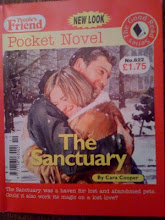
People's Friend serial 'The Lemon Grove'


Wednesday, 1 May 2013
Writing a Magazine Serial Part 4
This week I have decided to tackle pace and story arc in relation to writing a serial for women's magazines. Obviously, the story and the characters dictate both. However, for a serial to be compelling enough for readers to invest in it for a number of weeks, you need significant 'hooks' to keep the reader coming back. I can hear other writers thinking, dopey woman, we always need hooks, so what's different with a serial? This is true but of course with a novel or novella, the writer very much dictates exactly where the hooks go in and how major they are. The author largely orchestrates the ebb and flow of their tale. They might start with a very slow burn and work up to a crescendo. Or they might crash into the story with a scene at the start which smacks the reader between the eyes. It is true, when writing a novel, that one's editor may point out that a certain part of the book has gone a bit slack (it's not only in your pie baking that you can get a soggy middle) and they might ask you to up the action at certain points. However, when you craft a novel (as opposed to a serial), the ups and downs largely happen when you dictate them because the novel stands up very much as a whole. Also, when the reader reads it, they are the ones who decide how much they take in at any one sitting and whether they roll over and switch off the light after one chapter or whether they read into the small hours because your book is so compelling they can't put it down.
It is somewhat different with a weekly serial because even if the reader wanted to read the next three instalments they can't! Doing an 8 part serial, the length was around 5000+ words for each instalment. That is more than enough for each instalment to stand alone almost like a short story does. However, it also has to carry forward the central plotline whether that is a romance or a crime, a mystery or whatever. My over-arching plotline was a romance. That element of the plot was simple in that it began in instalment one and it ended in instalment 8. Along the way though there were many other plotlines which sometimes began and ended in one instalment but by and large would start in one instalment, carry over two or three (not necessarily consecutive instalments) and be wound up at whatever point seemed right. The thing is, if you're winding up plotlines say in instalment three or four you also MUST introduce new ones which can run over a few more issues of the magazine to keep the momentum going. As a fly-by-the-seat of your pants writer, who hates to plan, that was a tall order for me. However, without the necessity of doing a synopsis because that's what the editors demand, I think I could have come very unstuck. I had a major wobbly around instalment 6 where a number of side plots involving minor characters had come and gone. I simply could not think of another smallish plotline which was interesting enough to make readers buy the magazine the following week, but which was simple enough that I could easily resolve it by the end of instalment 8. Luckily, one of the older characters came to my rescue. She had been very much in the background, a character who had an identity only because other characters talked about her. It was time for Nana to step centre stage and I put her in a plot which involved her being unable to recover from a serious illness because of a wrong she had done many years before. Introducing this gave me an opportunity for readers to see her dilemma and wonder how she would resolve her guilt and make everything okay. That plot I used to keep readers 'on the boil' until the last two instalments when the major two plots of the serial - the romance and a crime - came together and the ends were all neatly tied up.
One of the key things in a magazine serial is the cliffhanger ending for each instalment. There were occasions when I fought with this. But once into the mode of writing serials I found that the cliffhanger ending would become obvious as I started to write, in other words as I started to structure the instalment I could 'spot' opportunities for the cliffhanger. The most important thing is that this doesn't have to be over dramatic. It doesn't have to be someone mangled in a car accident, or a revelation about a secret baby etc. A cliffhanger ending only needs to be enough to make someone curious enough to buy next week's magazine. So, although I did have some dramatic ones, I also had some more low key ones eg where a character had made a discovery and was scared stiff of telling someone else knowing the impact it would have upon them. It's worth, when considering writing a serial to study ongoing ones in magazines and making a note of the sort of cliffhangers they choose to give you an idea of how other writers handle this very important aspect of serial writing.
One of the best examples of this being done skillfully apart from in magazines is, to my mind, in a soap opera or a series such as Downton Abbey. With Downton, the inheritance was a major plotline which ran all the way through. Other plotlines such as romances between various characters, the imprisonment of characters, births, deaths and marriages came and went. Some plotlines taking up just one episode, others running for two or three or more. It would be a useful exercise, if one was setting out to write a serial to take perhaps the first series of Downton and make a note of the plotlines, what they were, when they started, and how long they lasted. You could do a lot worse than look at that to see how a serial could be plotted with enough action to keep people interested but without so much it became confusing. Add interesting characters and voila, you'd have the skeleton to give you an idea of how the pattern of a compelling serial is arrived at. That ends my series of posts on writing serials. I hope you've enjoyed it and will find it useful in writing your own.
Subscribe to:
Posts (Atom)